What is bruxism?
The term bruxism comes from the Greek brychein, meaning "to gnash the teeth." In dentistry it describes repetitive motor activity of the chewing muscles that manifests as clenching or grinding of the dental arches, often involuntarily.
Two main forms are distinguished: sleep bruxism, which occurs during sleep, and awake bruxism, which occurs during waking hours — typically as silent clenching during moments of concentration, stress or tension. The two forms can coexist in the same patient.
Prevalence varies between 5 and 10% of adults for sleep bruxism, while awake bruxism is even more common: roughly 20% of people are estimated to practise it unconsciously during the day.
Symptoms of bruxism: how to recognise it
Sleep bruxism is particularly insidious because sufferers have no direct awareness of the problem. The signs accumulate over time and are often attributed to other causes:
- Shorter, flatter or chipped teeth — enamel wear (attrition) is gradual, but becomes visible over years
- Morning headache, often concentrated at the temples or forehead — the result of prolonged contraction of the temporalis muscles during sleep
- Jaw pain or stiffness on waking — the mandible has been under tension for hours
- Temporomandibular joint (TMJ) pain, with clicking or popping when opening the mouth
- Tooth sensitivity to cold and heat, caused by thinning enamel
- Bitten cheeks on the inside — in some patients clenching also involves the mucous membranes
- Masseter hypertrophy — the muscle enlarges with overuse, making the jaw appear squarer
- A partner who reports nighttime noises — grinding can be loud enough to disturb a sleeping partner
Causes of bruxism
Bruxism is a multifactorial disorder: there is no single cause, but a combination of factors that varies from person to person.
- Stress and anxiety — the most well-documented cause, especially for sleep bruxism; the nervous system "discharges" accumulated daytime tension through the chewing muscles
- Genetic factors — bruxism tends to run in families; having a parent with the condition increases risk
- Medications — some SSRI antidepressants (fluoxetine, sertraline, paroxetine) are associated with increased sleep bruxism
- Sleep disorders — obstructive sleep apnoea is frequently associated with bruxism; those with apnoeas may grind in response to partial arousals
- Substances — caffeine, alcohol, nicotine and recreational drugs (particularly MDMA) intensify clenching
- Malocclusion — the role of dental occlusion in bruxism is debated in the literature; it is not a primary cause, but may contribute in some cases
How is bruxism diagnosed?
There is no blood test for bruxism. The diagnosis is clinical: it is based on the analysis of wear signs, evaluation of the chewing muscles, and the patient's history.
During the visit Dr. di Bari assesses:
- The occlusal surfaces of the teeth, looking for signs of attrition (wear from tooth-to-tooth contact)
- The length and shape of the front teeth, which characteristically shorten with chronic bruxism
- The chewing musculature — hypertrophied masseters are palpable at the cheek
- The temporomandibular joint: noises, clicks, limited opening
- Internal cheek impressions (linea alba) and any mucosal abrasions
In some cases, to evaluate the degree of wear or to plan reconstructions, a digital occlusal study or 3D case planning may be useful.
The night guard: how it works and why it matters
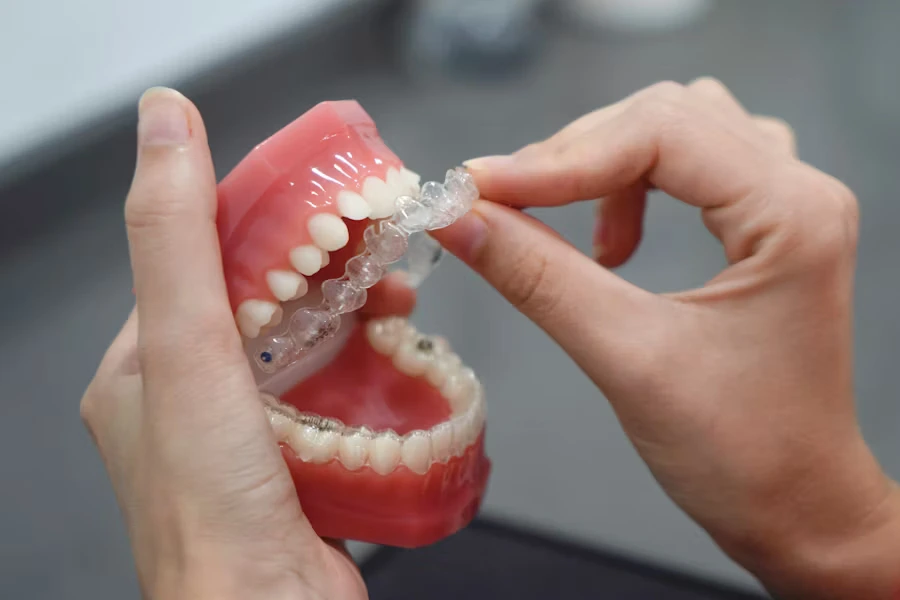
The first-line treatment for sleep bruxism is the occlusal splint (night guard) — a removable device made to measure from acrylic resin or thermoplastic material, worn during sleep.
How does it work? The guard interposes itself between the upper and lower arches, creating a uniform sliding surface that distributes clenching forces across the whole arch instead of concentrating them on individual teeth. This way it:
- Protects enamel from progressive wear
- Reduces load on the temporomandibular joint
- Relieves tension in the masseter and temporalis muscles
- In many patients, reduces morning headache within the first few weeks
When a night guard is not enough: other treatment options
In some cases the guard alone is insufficient, or the patient cannot tolerate wearing it during sleep. There are other complementary or alternative strategies:
- Maxillofacial physiotherapy — TMJ mobilisation techniques, stretching and muscle relaxation exercises; especially indicated when there is joint involvement
- Stress management — relaxation techniques, meditation, yoga, diaphragmatic breathing. This is not a "soft" alternative: research confirms that reducing stress levels reduces sleep bruxism activity
- Biofeedback — devices that detect chewing muscle contraction during sleep and send a signal (vibration or gentle sound) to interrupt the pattern
- Botulinum toxin in the masseters — in severe bruxism with marked muscle hypertrophy, botulinum injections into the masseters significantly reduce contraction force without affecting chewing function; the effect lasts 4–6 months and can be repeated
- Psychological evaluation — when bruxism is clearly linked to anxiety disorders or behavioural patterns, cognitive behavioural therapy (CBT) delivers long-term results superior to any mechanical device
Do you suspect you have bruxism?
Book a visit: we assess your tooth wear together and, if necessary, create a custom night guard to protect your teeth.
Article written by Dr. Luigi di Bari, Dental Studio in Manfredonia (FG). Last updated: May 2026.