Two paths to the same goal
Both fixed bracket braces and removable clear aligners have the same purpose: progressively moving teeth towards their correct position. But they do so differently, with different timescales, and are indicated for different situations.
The choice between the two isn’t just aesthetic or about comfort: it is above all clinical. Some malocclusions respond better to fixed brackets; in other cases, aligners produce equivalent or superior results. Getting the assessment right makes the difference between a treatment that works and one that disappoints.
Clear aligners: advantages and limitations
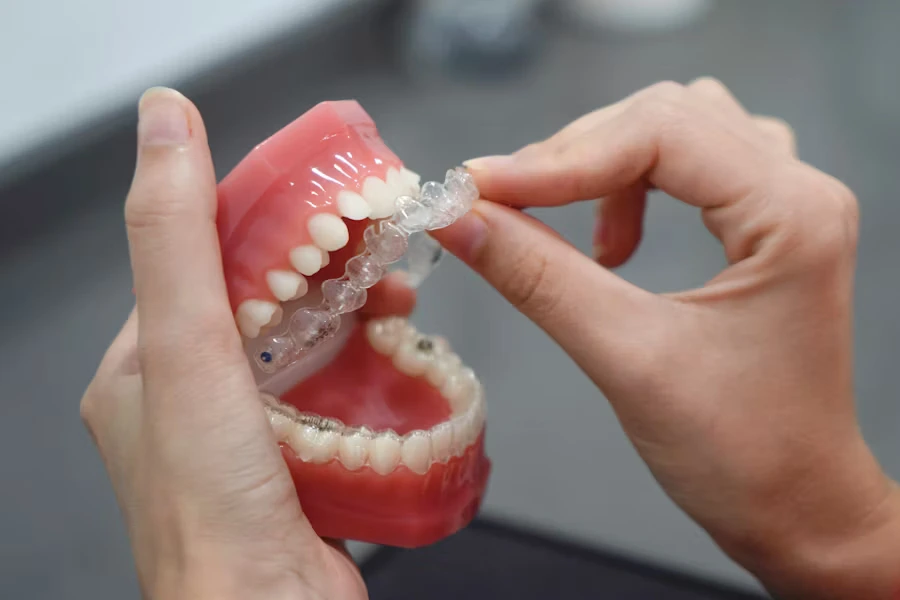
Clear aligners are custom-made resin trays produced from a 3D scan of the dental arch. Each set moves teeth by fractions of a millimetre, and is replaced on average every 10–14 days. The full treatment can require 10 to 30 sets, depending on case complexity.
Key advantages
- Almost invisible: most people around you won’t notice you’re having orthodontic treatment.
- Removable: taken out to eat, drink coloured liquids and for oral hygiene. No dietary restrictions.
- Easier hygiene: without brackets, brushing and flossing is much simpler — reducing the risk of cavities during treatment.
- Greater comfort: no wires breaking, no brackets irritating the cheeks.
- Shorter and less frequent visits: typically every 6–8 weeks, compared to 4–6 for brackets.
Limitations to be aware of
- Require discipline: aligners must be worn at least 20–22 hours a day. If removed too often, treatment slows or fails.
- Not suitable for all malocclusions: more complex cases (severe rotations, marked overjet and overbite, extractions needed) are often better managed with fixed brackets.
- May cause mild speech difficulty in the first weeks of adjustment.
Fixed brackets: when they’re the better choice
Fixed brackets — in metal or aesthetic ceramic — remain bonded to the teeth throughout treatment and are activated periodically by the clinician. They are the most evidence-backed orthodontic solution, with decades of documented cases.
When brackets are superior
- Complex malocclusions: marked rotations, severe space discrepancies, cases requiring dental extractions.
- Patients in the growth phase (children and adolescents), where jaw growth needs precise guidance.
- Situations where patient compliance is uncertain: with brackets, the appliance works 24 hours a day regardless of the patient’s choices.
- Orthognathic treatments combined with jaw surgery.
Quick comparison
| Aspect | Clear aligners | Fixed brackets |
|---|---|---|
| Visibility | Almost invisible | Visible (metal) / almost invisible (ceramic) |
| Removability | Yes (20–22 h/day) | No |
| Oral hygiene | Easier | Requires more attention |
| Complex cases | Limited effectiveness | Preferred indication |
| Average duration | 6–18 months | 12–30 months |
| Discipline required | High (patient must wear them) | Low (always working) |
| Ideal age | Adults and adolescents | Children, adolescents, adults |
Want to know which orthodontic option suits your situation?
Book an orthodontic assessment visit. We’ll analyse your case together and identify the best path.
Retention: the step no one talks about enough
Whatever treatment you choose, orthodontics doesn’t end with the last aligner or the removal of brackets. Without retention, teeth tend to partially relapse towards their original position. Fixed retainers (a thin wire bonded to the back of the front teeth) or removable retainer trays are used to maintain the result over time — ideally indefinitely.
This is one of the aspects we pay most attention to in our practice: the end of active treatment is the beginning of a maintenance phase that determines whether the result lasts for years — or just a few months.
Article written by Dr. Luigi di Bari, Dental Studio in Manfredonia (FG). Last updated: May 2026.